Samuel Annesley: The St Paul of the Nonconformists, by Norman L. Hopkins
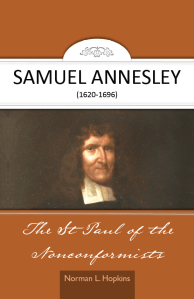
Samuel Annesley (1620–1696) followed in the footsteps of the Apostle Paul in having ‘the care of all the churches’ on his heart. Until now remembered mainly for his famous grandchildren, John and Charles Wesley, Samuel Annesley was a key labourer among the Nonconformists in his own right.
Minister of St Giles, Cripplegate in London, Annesley was ejected in 1662, and afterwards took the lead in organising the Morning Exercises, the published version of the early morning weekday meetings for prayer and exhortation which made such a huge contribution in the mid-1600s to stabilising the people in sound theology and wise Christian living. Annesley himself published a famous sermon on conscience (included in this volume), explaining how the conscience works and giving practical gospel advice on how to achieve God-honouring peace of conscience.
Norman L. Hopkins recounts the life of Samuel Annesley, bringing in a wealth of background information which allows us to situate Annesley in his context while letting Annesley’s own character and contributions shine through.
This volume also brings to light the life and labours of another almost-forgotten figure, Annesley’s friend Thomas Brand. Brand (1635–1691) worked zealously in and around Staplehurst, Kent, throwing himself into not only preaching but also catechising, holding prayer meetings, distributing quality Christian literature, and one-to-one evangelism. An appendix in this volume provides Annesley’s biographical account of Thomas Brand, as well as the sermon Annesley preached at Brand’s funeral.
This is the third title in the Evangelical Lives series – a series of small biographies of 17-18th century Christians in the British Isles whose lives are long forgotten or regarded as marginal.
Paperback, 302pp, £6.95 plus p&p. Place an order.
ISBN 978-1-915777-23-2
Endorsements
A quiet but potent ‘mover and shaker’ among the Dissenters of the seventeenth century, Samuel Annesley gives us a pattern of faithfulness and fruitfulness during difficult and dangerous times. Here we find a man who, with little regard for the opinion of men, took his opportunities to serve the Lord as they came. Norman Hopkins’ biography offers a wealth of incidental detail of a life with a savoury influence, full of thought-provoking incident and rich with happy instruction.
— Jeremy Walker, Pastor of Maidenbower Baptist Church, Crawley
Norman Hopkins has produced a very informative and readable account of the life and labours of Samuel Annesley, the maternal grandfather of John and Charles Wesley. It is full of interesting political, ecclesiastical and social detail relating to the period yet without distracting from the main character. The book highlights Annesley’s contacts with so many of the leading Puritan preachers and theologians of the day. The appendices provide further fascinating insights into the ministry of this Presbyterian minister whom the state forced into Nonconformity. I warmly recommend this biography.
— Philip Eveson, Principal Emeritus of London Theological Seminary
For those who appreciate Puritan theology, the six volumes of the Morning Exercises are a wonderful resource. They were intended to give guidance for dealing with the challenges to the Christian life. What is not so well known are the circumstances under which they appeared. They are sermons preached on weekdays to Christians who were about to set off to work. The first appeared before the outbreak of Nonconformist persecution after 1662. The organiser was Samuel Annesley, grandfather of John and Charles Wesley. Norman Hopkins has diligently researched Annesley’s life, revealing a man of rich experience, a pastor who served in town and country as well as being for a time a naval chaplain. He was well-equipped to identify the challenges to the Christian life and also the men who could well address them.
— Robert W. Oliver, Retired pastor and lecturer in Church History
at London Theological Seminary
Once again Norman Hopkins has opened a window on church history. He is using his ‘retirement’ years well to help us discover characters from his native Kent profoundly used of God and yet sadly forgotten by the church. In this book we are given details of the many trials connected with living for the truth in the seventeenth century, but his chapter on preaching is so helpful in a time when too many are content to simply explain a passage. In every age preachers need to be ‘adaptable … clear … practical … pastoral and experimental.’ We look forward to his next ‘discovery.’
— Bernard Lewis, Retired pastor, missionary and lecturer in Pastoral Theology
 Ettrick Press